





























Plastic Monofilament Basics: Melting Point ≠ Heat Deflection Temperature — Stop Mixing Them Up
Many purchasers and filament professionals treat the melting point as the maximum service temperature. That is a misconception.
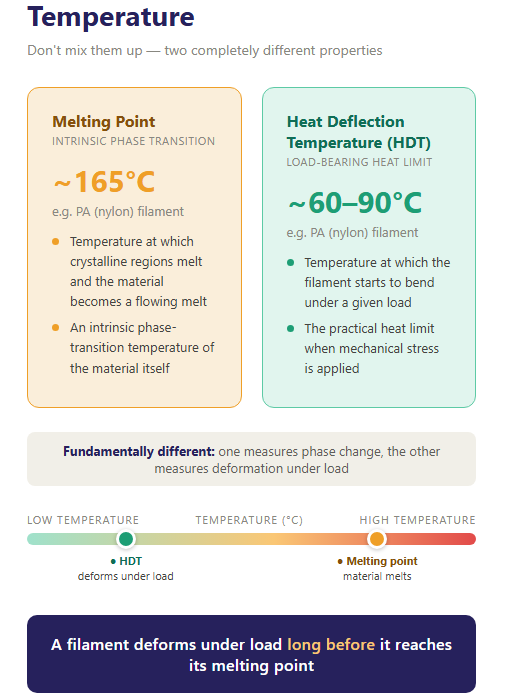
The melting point is the temperature at which the material melts and flows — a processing reference used in filament production. Only around this temperature does the monofilament soften enough for extrusion spinning.
The heat deflection temperature, by contrast, is a service metric under load. Under heat, friction and pressure, filament softens, bends and loses resilience well before its melting point is reached — and takes a permanent set.
Crystalline monofilaments contain both crystalline and amorphous regions. As temperature rises, the amorphous regions soften first and deform easily under load; only at still higher temperatures do the crystalline structures melt. Take nylon: its melting point sits above 200 °C, yet under load it can deform at just 80–90 °C.
Remember it simply: the melting point governs processing; the heat deflection temperature governs real-world use. Brief, unloaded exposure to high temperature can approach the melting point; but for continuous work under load, always select filament by HDT. Use the wrong parameter and the filament will deform and be scrapped on the machine — a costly mistake.


